TMJ Disorders - An Elusive Hellscape
Exploring the woefully misunderstood and frustrating condition.

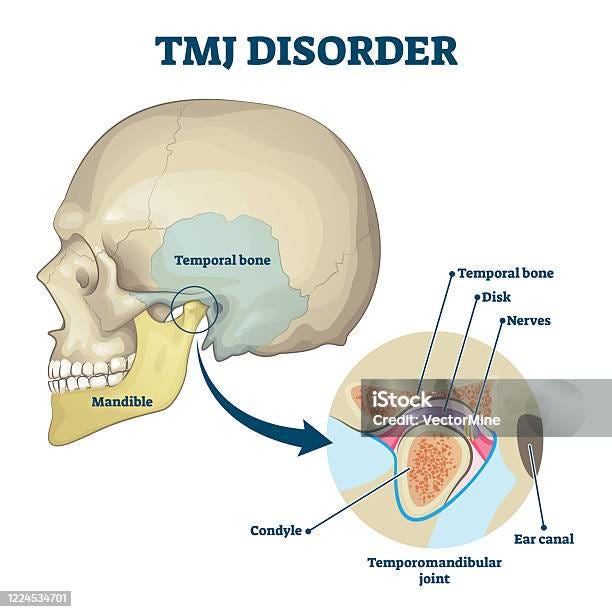
‘TMJ’, ‘TMD’ or ‘Temporomandibular joint dysfunction’, whatever you want to call it, is an umbrella term for a variety of disorders that cause pain and dysfunction in the lower jaw.
It’s not something widely known about, but it’s very prevalent, occurring in 34% of the global population. It’s also the second most common cause of orofacial pain after toothaches!
Anecdotally speaking, I live with the disorder. And I wanted to outline how frustrating this condition is for someone to deal with. So, we’ll start right at the beginning with what it is like for someone discovering that they have this disorder.
Stage 1: The ‘WTF is going on’ stage.
TMJ is a very ambiguous condition. It presents as something that crosses the boundaries of a variety of healthcare disciplines. This make’s the condition difficult to nail down, and it’s often misdiagnosed as trigeminal neuralgia, chronic sinus issues, tension headaches, tooth issues, and fibromyalgia.
In my case, I began experiencing headaches, jaw discomfort and quite severe muscular pain in my neck. I consulted with my GP and wound up jumping through a variety of hoops. I was referred for an MRI, Post-Shingles Neuralgia was suspected, despite my never having had shingles. My doctor was essentially stumped. So… I went to more doctors. By the time I saw a neurologist, I was at my wits end. I had essentially taken myself in circles, and no one, not a single GP or specialist, had even remotely mentioned TMJ as a possibility.
My dentist suspected Bruxism (clenching) as a cause, and referred me to another specialist clinic, it was there that I finally was informed about the potentiality of my having TMJ disorder.
I’ve just condensed months of health anxiety into a few short paragraphs. It is difficult to render how frustrating it is, to endure months of pain, to see a wide variety of health specialists, and to not even remotely know the cause. For such a common condition, I am surprised that this was the reality I faced.
Once I finally had a clue as to what I was suffering with, I was ready to take action and get on top of things, I’d had enough of the constant pain.
Stage 2: Lots and lots and lots of options.
It was suggested that I get Botox injected into my deep masseter muscle. It was also suggested that I get a fitted dental ‘Splint’ to manage nighttime clenching that may have been inflaming the lower jaw joint region. I also was recommended regular physiotherapy sessions to manage muscular pain and to learn a variety of jaw exercises that can assist in managing pain. It was also suggested that I should refer to a psychologist, as a good deal of pain from TMJ can be exacerbated by overt focus on ones symptoms, a psychologist is able to assist with pain management in the sense that they can assist in making you more mindful about the pain.
All of these options were packaged with a daunting reality. “This may not work” was always a reply you’d receive upon asking about the potential for a treatments effectiveness.
Out of respect to the practitioners, I do want to give credit to a vast majority of them for being professional in how they navigated discussing the treatment of the disorder. But the reality of the situation was, there’s no clear cut path toward getting better with the disorder. It is remarkably complex in nature, and even with interdisciplinary attention, it’s still difficult to treat.
Stage 3: Depression
When you try with earnest to help yourself and are met with failure after failure, a form of depression arises. I felt really alone and turned to online communities, which really didn’t help.
The subreddit r/TMJ is a stark and grim place to browse. It’s littered with posts from hopeless people who are desperate for whatever form of help can be offered up to them. Some of the personal experiences you see written about on there are ridiculous in how discouraging they are. People have been seeing specialist after specialist for years.
It’s no wonder that this condition drives people around the bend. There are a great deal of posts from people legitimately venting, stating that they feel as though they cannot go on living as a result of the constant pain they suffer from.
Stage 4: Living with it
I don’t think anyone wants to learn with any form of chronic pain, but it’s something that a lot of people have to do.
I feel a great deal of empathy for all of the people out there who have tried so hard to resolve symptoms caused by this disorder, who are left floundering without answers. It’s made me reflect on all the other forms of chronic pain conditions that exist, and left me feeling really saddened by how hopeless it makes people feel.
There’s always two sides to every coin though, and in this case, it’s important to know that there’s a remarkable amount of people who manage the pain and frustrating ambiguity of this condition, and go on living wonderful lives.
Luckily for me, I feel as though I’ve learnt to manage the disorder a good deal. I’ve done this through relaxation techniques, jaw exercises and conscious adjustment of my jaw each day to ensure it’s not retracted or clenching. I still deal with a lot of annoying symptoms and consult with a TMJ specialist clinic in order to manage the effects of the disorder.
Overall, I guess I’m just trying to outline here that, for such a common disorder, there is SO much ambiguity about it, and SO much misdiagnosis. I really think that much more could be done in order to reduce the amount of suffering that people endure. A faster path toward diagnosis of the disorder must surely be possible, and I think it’s something that should be worked toward amongst medical professionals.
I hope that gives some sense, on an anecdotal level, of what it’s like for someone living with this disorder. And that I’ve brought some attention to something that is woefully underdiscussed.